
Parashat Ki Tetze – Justice That Restores Hope
Ki Tetze is a Torah portion about building a society founded on moral responsibility, not merely a collection of laws. One of its most beautiful qualities is that the Torah does not simply say, “Be good people.” It goes into detail: Do not pervert justice due to the stranger and the orphan; do not violate the rights of the widow; pay a worker on time; and leave part of the harvest for the stranger, the orphan, and the widow. Justice in judgment – do not distort the law, especially when the person before you is unable to defend himself. Responsibility toward the vulnerable – the Torah does not leave the poor, the stranger, and the widow dependent only on private charity. It creates a place for them within society. Even a sheaf forgotten in the field is not taken back by its owner—it is left for them. Human dignity – even with regard to a hired worker, the Torah requires payment on time, recognizing that his wages may be his immediate means of survival. Personal responsibility – “Each person shall be put to death for his own sin.” A person should not bear punishment for the sin of his father or his son. This expresses a powerful principle of personal responsibility and justice. Ruth is precisely one of the people whom the Torah seeks to protect: a foreign widow in a vulnerable position. She goes out to glean in the fields, and the biblical law of leaving the gleanings allows her to survive with dignity. Boaz, by contrast, holds a position of strength: he has land, wealth, and status. But the true test is not how much power he has - it is what he chooses to do with that power. Boaz does not allow emotion to override responsibility. He acts according to the law of redemption, cares for Ruth, and above all, does not forget Naomi or her family's inheritance. In Parashat Ki Teitzei, the Torah teaches how a strong society should treat the vulnerable. In the Book of Ruth, we see this principle become human and tangible: Ruth and Naomi are in need, and Boaz chooses to take responsibility. In my painting of Naomi, Ruth, and Obed, it is not only Ruth who finds a home, and not only a child who is born. Naomi, who has lost her family, receives continuity and hope once again |
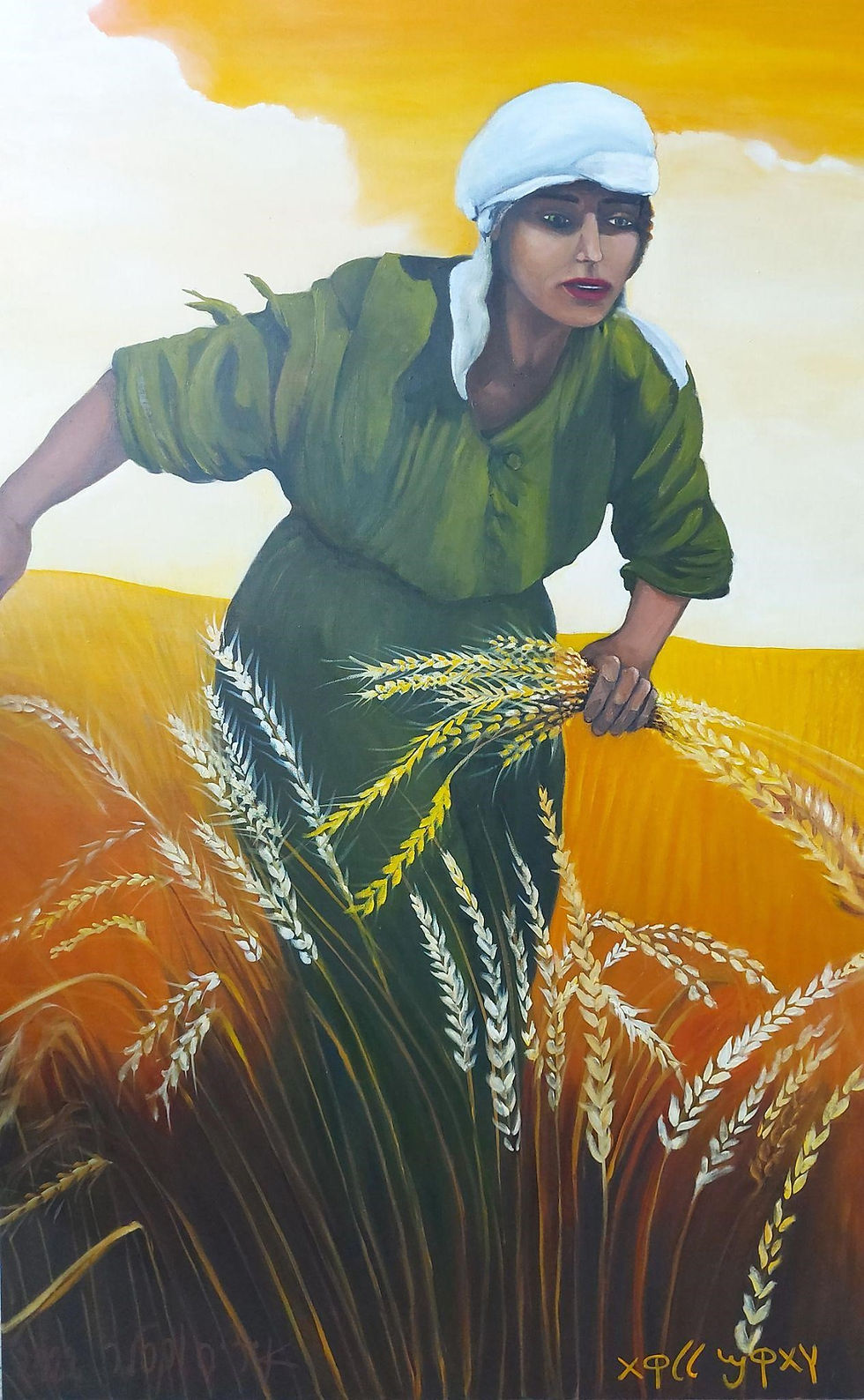 |
“Then she rose up to glean” appears in the Book of Ruth (Chapter 2, Verse 15).
At the end of the story, Obed is born. And the women say to Naomi: |
“A son has been born to Naomi.” |

“who is better to you than seven sons” appears at the end of
the Book of Ruth (Ruth 4:15).

Therefore, in my painting Naomi, Ruth, and Obed, I see much more than a family moment. I see a woman who has lost everything—and who is given family, continuity, and hope once again. Perhaps this is one of the most beautiful messages of Parashat Ki Teitzei and the Book of Ruth. Justice is not only about judging rightly Sometimes justice means making sure that those who have fallen can rise again. |


Comments